
Feast of Our Lady of the Immaculate Conception
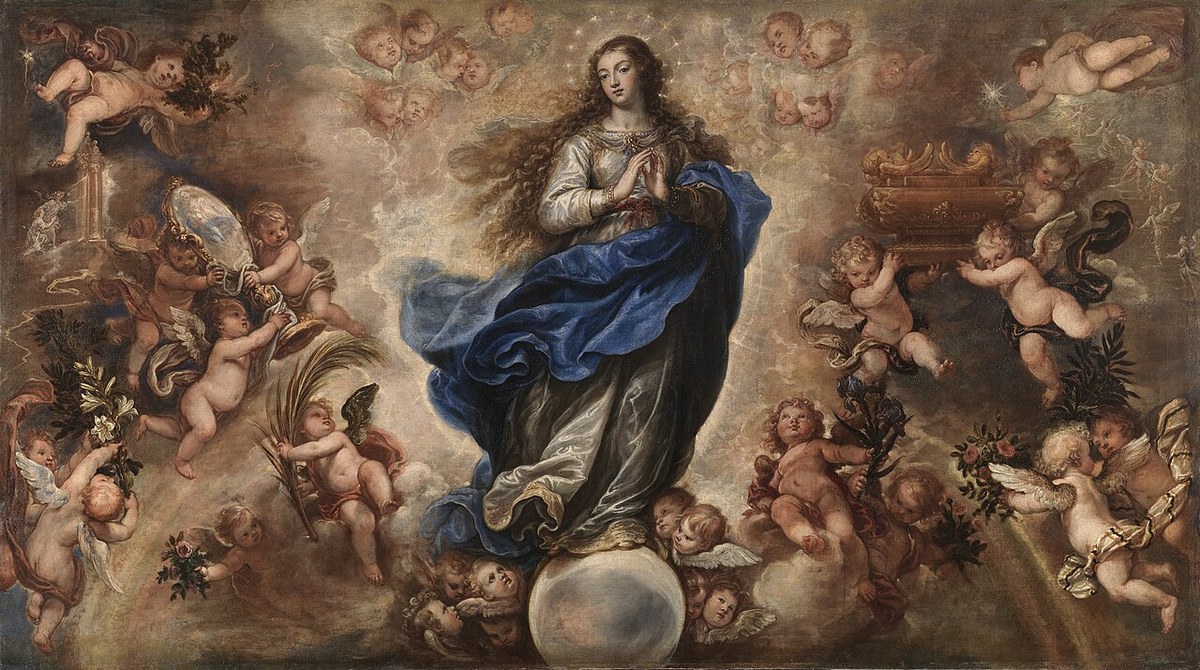
The Solemnity of the Immaculate Conception celebrates the Immaculate Conception of the Blessed Virgin Mary, on 8 December, nine months before the feast of the Nativity of Mary on 8 September. It is one of the most important Marian feasts in the liturgical calendar of the Latin Church. By pontifical decree, it is the patronal feast day of Argentina, Brazil, Chile, Italy, Korea, Nicaragua, Paraguay, the Philippines, Spain, the United States, and Uruguay. By royal decree, it is designated as the day honoring the patroness of Portugal. Since 1953, the Pope visits the Column of the Immaculate Conception in the Piazza di Spagna to offer expiatory prayers commemorating the solemn event. The feast was solemnized as a holy day of obligation on 6 December 1708, by the papal bull Commissi Nobis Divinitus of Pope Clement XI. It is celebrated with Masses, parades, fireworks, processions, food and cultural festivities in honor of the Blessed Virgin Mary in Catholic countries.
Origins
The Eastern Church first celebrated a Feast of the Conception of the Most Holy and All Pure Mother of God on 9 December, perhaps as early as the 5th century in Syria. The original title of the feast focused more specifically on Saint Anne, being termed Sylepsis tes hagias kai theoprometoros Annas ("conception of Saint Anne, the ancestress of God"). By the 7th century, the feast was already widely known in the East: on at least two occasions in the Acta of the Third Council of Constantinople (680-681), regarded as ecumenical by both the Catholic and Eastern Orthodox Churches, Mary is called "immaculate" (Achrantos). Most Orthodox Christians reject the Scholastic definition of Mary's preservation from original sin. The feast associated with her immaculate conception, initially celebrated on 8 December, was translated to the Western Church in the 8th century. It then spread from the Byzantine Southern Italy to Normandy during the Norman dominance, eventually reaching England, France, Germany, and Rome. In 1568, Pope Pius V revised the Roman Breviary, and though the Franciscans were allowed to retain the Office and Mass written by Bernardine dei Busti, this office was suppressed for the rest of the Church, and the office of the Nativity of the Blessed Virgin was substituted instead, the word "Conception" being substituted for "Nativity". According to the papal bull Commissi Nobis Divinitus, dated 6 December 1708, Pope Clement XI mandated the feast as a holy day of obligation which is to be celebrated in future years by the faithful. Furthermore, the pontiff requested that the papal bull be notarized in the Holy See to be further copied and reproduced for dissemination. Prior to Pope Pius IX's definition of the Immaculate Conception as a Catholic dogma in 1854, most missals referred to it as the Feast of the Conception of the Blessed Virgin Mary. The festal texts of this period focused more on the action of her conception than on the theological question of her preservation from original sin. A missal published in England in 1806 indicates the same collect for the feast of the Nativity of the Blessed Virgin Mary was used for this feast as well. The first move towards describing Mary's conception as "immaculate" came in the 11th century. In the 15th century, Pope Sixtus IV, while promoting the festival, explicitly tolerated both the views of those who promoted it as the Immaculate Conception and those who challenged such a description, a position later endorsed by the Council of Trent. The proper for the feast of the Conception of the Blessed Virgin Mary in the medieval Sarum missal merely addresses the fact of her conception. The collect for the feast reads: O God, mercifully hear the supplication of thy servants who are assembled together on the Conception of the Virgin Mother of God, may at her intercession be delivered by Thee from dangers which beset us.
Text adapted from Wikipedia, available under the CC BY-SA 4.0 licence.